Showing posts with label SE-ERGO. Show all posts

9/18/2021

Training Ergonomics risk analysis


Ergonomic two-month online workshop - from October 2, 2021 

Seminar information:
Agency SE-ERGO 
📧 agencijaseergo@gmail.com
      ergofriendlyinternacional@gmail.com


10/07/2020

Movement analysis


The study of schedule of a technological operation reveals the schedule that allows a shorter path of movement and optimal sequence of grips and movements in the operation. Better schedule and sequence lead to the increasing of labour productivity and better humanization in work, as well as better utilization of existing resources, shortening the total length of moving the objects of work, reducing the number of grips, shortening the duration of the operation.

Organizational model is different from the production technology and it can be made in a written form or acquired during a long series of repetitions, and it is caused by:

  • schedule in the workplace,
  • sequence of performing the task and
  • interdependence of performing the grips.

 The following rules are particularly important:

• workplace must have the optimal size,

• working conditions should correspond to standards,

• equipment should enable work in a standing or sitting position (employee elects)

• equipment should be located in the optimal zone is selected according to the frequency of handling,

• arrange the equipment to provide the optimal sequence of movements in the operation and

• arrange the equipment for supplying the workplace so that it should be optimal in relation to employees and inter phase transport.


3/23/2019

Organization analysis


The starting point for an organization review is an analysis of the existing circumstances, structure and processes of the organization and an assessment of the strategic issues that might affect it in the future.  

The external environment
The economic, market, competitive, social and legal matters that may affect the organization. Plans for product-market development will be significant.

The internal environment
The mission, values, organization climate, management style, technology and processes of the organization as they affect the way it functions and should be structured to carry out its function. Technological developments may be particularly important, as well as the introduction of new processes such as just-in-time or the development of an entirely new computer system.

Strategic issues and objectives
As a background to the study it is necessary to identify the strategic issues facing the organization and its objectives. These may be considered under such headings as growth, competition and market position and standing. Issues concerning the availability of the required human, financial and physical resources would also have to be considered.

Activities
Activity analysis establishes what work is done and what needs to be done in the organization to achieve its objectives within its environment. The analysis should cover what is and is not being done, who is doing it and where, and how much is being done. An answer is necessary to the key questions: are all the activities required properly catered for? Are there any unnecessary activities being carried out, i.e. those that do not need to be done at all or those that could be conducted more economically and efficiently  by external contractors or providers?

Structure
The analysis of structure covers how activities are grouped together, the number of levels in the hierarchy, the extent to which authority is decentralized to divisions and strategic business units, where functions such as finance, HR and research and development are placed in the structure and the relationships that exist between different units and functions (with particular attention being given to the way in which they communicate and cooperate with one another). Attention would be paid to such issues as the logic of the way in which activities are grouped and decentralized, the span of control of managers, any overlap between functions or gaps leading to the neglect of certain activities, and the existence of unnecessary departments, units, functions or layers of management.


2/18/2019

We need to stand more often


Because:

1. Standing reduces risk of weight gain and obesity.

2. Standing vs sitting lowers risk of heart disease.
3. Standing helps lower risk of type 2 diabetes and other metabolic diseases.
4. Standing lowers long-term mortality risk.
5. Standing helps reduce the risk of cancer.
6. Standing can help ease or reduce chronic back pain.
7. Standing helps increase energy levels and improve mood.
8. Standing while working boosts productivity.
9. Standing while working helps tone muscles.


2/07/2019

Physiological conditions


When the requirements of work are such that a man can overcome them by making an effort, the functional ability of his body and his health are not endangered and there is ergonomic balance. In that sense, the physiology of work deals with:
Defining the workload;
Defining the requirements of work;
Studying human physiological abilities and the size of physiological effort he can make in order to respond to the requirements of work.

(1) Defining the workload

Performing each work is a kind of a burden for the body. The type, intensity and duration of the load depend on the work. Physiological workloads should be such that the body can respond to them through physiological functions, i.e. to maintain homeostasis when working. The load that can not be overcome leads to disorders of homeostasis (the balance in the body is lost) which is an overload that causes fatigue. In case of further increasing the intensity of overload, there is a pathological response of the body, i.e. fatigue. 
Loads can be physical, mental and sensory.

Physical work (the work of skeletal muscles) is a major cause of physical load because of work. Physical work means the work that a man does while overcoming the burden and resistance. Physical work can be dynamic and static work.

(2) Defining the requirements of work

Requirements of work define what the workload and adverse effects require from the organism of workers and can be the following:
- Requests for certain functions of the organism. In addition to general health conditions, the work requires some particularly preserved functions of organs and systems or some particularly preserved or marked morphological features of a man
- Requests for certain age limits of a worker. Depending on the age, some functions are established, some are changed, some disappear or are reduced, so that the same work shall not place the same demands on quite young, middle-aged or older workers
- Requests for a specific sex of a worker. These requirements are not common, and are based on specific differences in the physiology of female and male body

(3) Size of physiological effort

A man must make an effort in order to deal with the load imposed by a certain work. The analysis of work can specify which functions of the body will be exposed to the influence of that work. So the individual workplace should always be analysed, not the occupation.

The bigger the load is, the bigger the effort is, although not all the people make the same effort to deal with the same load. In determining the effort, the following has to be determined:
- the limit of physiological strain at rest,
- the level of physiological response to  work impact, and
- the boundary between physiological and pathological responses.


Read more: ERGONOMICS IN THE GARMENT INDUSTRY

9/29/2018

ERGONOMIC OFFICE


SE-ERGO invite you to the ergonomic preventive seminar ERGONOMIC OFFICE that will be held on October 5, 2018 at the Zepter Hotel in Belgrade.


All information at:

10/19/2017

Mapping of Textile Industry in the Western Balkans Region


Workshop “Industrial Relations” and “Case Studies on Collective Agreements” in Specific Sectors – Telecommunications & Textile, 11-13 October 2017, Belgrade, Serbia 


9/18/2017

International ERGO-FRIENDLY membership


Be one step ahead of the others ...

Increase your target group with an additional value by the International ERGO-FRIENDLY membership.

Membership fee for the first 6 months is free. 

What are the benefits?
- By obtaining ergonomic analysis and certificate you become an International ERGO-FRIENDLY member and you have the right to use the logo in your own marketing purposes.
- The membership is a valuable instrument for increasing your customer loyalty. It shows that you care about their health.
- You distinguish yourself from the competition.
- You get new customer in a new way.

Or increase your target group with an additional value by the ERGO-FRIENDLY Certificate.

Ergonomic muscle-bone disorders are the fastest growing among all the categories of diseases. They account for 56% of all diseases, and 90% of the population have frequent spinal problems. Show your customers that you take care of their back, shoulders, neck, ankles ...


9/11/2017

CIS Institute and SE-ERGO


The importance of ergonomics was recognized by the top-level laboratory CIS Institute in 
Belgrade. Today with SE-ERGO they have employee training - because they care!

60 years of service to the textile industry....


6/30/2017

Ergonomic design by e-mail


At your request SE-ERGO ergonomic design by e-mail.

Jobs / mobile offices / housework / gardening ... wherever you are ...

Send a photo of your workplace - and you will receive an email with an analysis and recommendation for ergonomic positions and postures.

Quickly and efficiently - time is money! Money invested in ergonomics returns multiple times ...


6/18/2017

Cognitive ergonomics


Cognitive ergonomics deals with mental processes such as perception, memory, thinking and mobility and the way they are affected by the interaction with the remains of the observed system. The most important aspects include mental effort, decision making, interaction with computers, human reliability and work stress.

Cognitive ergonomics concentrates on the analysis of thought processes: mental work load, decision making and planning that are required from knowledge workers (Marmaras and Kontogiannis, 2001).

The process by which a human is orientated among phenomena and things of the outside world is called the cognitive process consisting of: feeling, perception, learning, thinking and memory.

Senses are reflections of certain features of objects and phenomena of the outside world in our minds.
Perception is a process that gives meaning to sensory information, connects previous experience and current experience, establishes and maintains internal cohesion and unity of knowledge about the relevant parts of the outside world, or reality in general. Important objects of perception in organizations are:
o   The perception of work performance.
o   The perception of organizational roles.
o   The perception of personality.
o   The perception of certain groups or categories of members of the organization.

Read more: Colovic G., Ergonomics in the garment industry, Woodhead
Publishing Limited,  2014

2/26/2017

SE-ERGO


CONSULTING AGENCY 

AGENCIJA ZA KONSULTANTSKE USLUGE

Services


  • Ergonomic design of the workplace
  • Lectures
  • Seminars
  • Consultation
  • Training
  • Posters (ergonomic advice)

Focus

Our focus is "smart work" and optimization of workplaces with lean system!

CONTACT US FOR THE BEST SOLUTION FOR YOU AND YOUR WORKPLACE

email: agencijaseergo@gmail.com


8/29/2015

STANDARDIZATION OF WORK

Standardization of work is a sensitive area of management activity, so mistakes are very common to occur. The risk of error is twofold: if the standards are set too low and if they are set high. In both cases the work efficiency is being lost.

Standardization of work and determining of standards are carried out through seven steps:

2/06/2015

The Garment Manufacturers Risk Assessment – Swot Analysis

Risk is defined as calculation forecast emergence of negative events (hazards) 
that cause loss or calculation forecast emergence of positive events 
(opportunities/chances), which bring us benefits .

Risk is a condition in which there is a possibility of negative deviations from 
the desired outcomes that we expect or hope will happen. In terms of business, 
risk is an unfulfillment of desired business objectives and it must include 
threats and opportunities from the environment that can potentially contribute to 
the growth and development of the company, but prevent development, and 
thus endanger the very survival of a company.


2/05/2015

Sitting or Standing Operator Workplace?

In the design of the workplace, the position of the operator must be considered. Should the operator work from a sitting position, standing position or a combined sitting and standing position? 

Sitting is physiologically most favorable position at work and should be used whenever the nature of the work allows. When sitting, a human spends only about 5% more energy than when lying quietly. What the static muscle strain will be while sitting depends largely on the design of the chair and its connection to the workplace. Sitting, if the body is supported ideally, consumes 20% less energy than standing when doing the same job. The pressure on the spine in a sitting bent position is up to 50% less than in the upright standing. 
Workers position in workplace
When sitting the energy consumption is reduced, and the legs are free of load. Sitting gives stability to the upper body and less strain on the cardiovascular system. According to research, people tend to sit: 
  • At the front of the chair seat 15%.
  • In the middle of the chair seat 52%.
  • On the back of the chair seat 33%.
  • Leaned back in the chair 42%, and
  • Hands resting on the table 40%.

Problems arising when sitting are the following: 
  • deviation of the spine,
  • weakening of the abdominal muscles – so-called "sitting stomach", and
  • bad effect on digestive organs.

For comfortable sitting not only the characteristics of the seat and backrest are important, but also the other factors such as feelings, relief, comfort and relaxation of the body, as well as fatigue, biomechanical conditions, stress and blood circulation. According to De Looze, Kujit-Evers and Van Dieën J. theoretical model of comfort and discomfort and its underlying factors at the human, seat and context level. 
Worker position diagram
Worker position diagram 
Where prolonged sitting at work is required, the following measures should be taken: 

1. Adopt a good sitting position by learning how to adjust the workstation to fit individual needs for specific tasks. 
2. Select a chair with: 
  • controls that are easy to operate from sitting position
  • a seat that adjusts for both height and tilt
  • a seat that does not put pressure the back of thighs or knees
  • a backrest that is shaped to support the lower back and does not give way
  • a front edge curved downwards
  • non-slip, breathable fabric on the seat
  • a stable five-point base
  • a minimum seat width of 40 cm
  • arm rests where practical, that do not interfere with free movements within the workstation
3. Adjust the chair’s height to 25-35 cm below the work surface. 
4. Introduce five minutes of exercise, such as walking for every 40 to 50 minutes of sitting. 

Standing is one of the basic positions of the body. Standing workplace is defined as the workplace at which the task is done in a relatively static standing position at one workplace. In a standing position, the body is held upright with the help of large muscles of the lower extremities and trunk. When standing with the help of the upper extremities the burden can be carried, with the movements of lower torso and legs used to enable the force to move these loads. In order to perform work tasks certain movements of the whole body must be performed, such as bending, turning and moving the trunk, reaching up and aside, while the legs remain in a relatively stable position. 

Standing, in contrast to sitting, includes the static strain of major muscle groups, so that the energy consumption is by about 10-15% higher than at rest in a lying position. But standing is a very productive position for people with regard to the fact that energy consumption and normal standing on two legs hardly require any effort. Moderately hard and difficult task should be performed while standing, because the body must use large force. In applying large forces the body uses large muscles that are found on the shoulders, back and thighs. 

A person's body is affected by the arrangement of the work area and by the tasks that he or she does while standing. The layout of the workstation, the tools, and the placement of keys, controls and displays that the worker needs to operate or observe will determine, and as rule, limit the body positions that the worker can assume while standing. As a result, the worker has fewer body positions to choose from, and the positions themselves are more rigid. This gives the worker less freedom to move around and to rest working muscles. 

Different body positions during working
The basic principles of good job design for standing work are: 
  • Change working positions frequently so that working in one position is of a reasonably short duration.
  • Avoid extreme bending, stretching and twisting.
  • Pace work appropriately.
  • Allow workers suitable rest periods to relax; exercises may also help.
  • Provide instruction on proper work practices and the use of rest breaks.

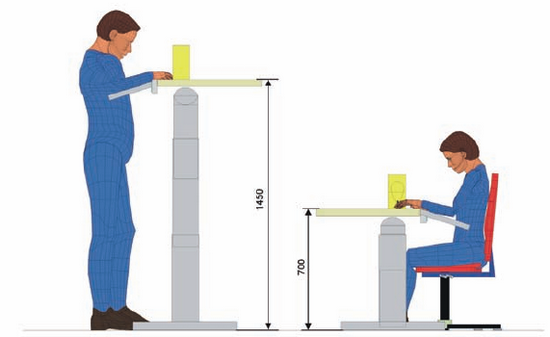
Continuous standing or sitting while working is a common source of discomfort and fatigue. Frequent changes of body positions, including alternating between sitting and standing, help to avoid fatigue. It is therefore desirable to have both standing and sitting arrangement for any work task. Whenever possible, a worker should be able to work sitting or standing at will. 

References 
  1. Colovic G (2010). Management of technology systems in the garment industry, Woodhead Publishing Ltd.
  2. Colovic G (2014). Ergonomics in the garment industry, Woodhead Publishing Limited Ltd.
  3. De Looze MP, Kujit-Evers LFM and Van Dieën J (2003), 'Sitting comfort and discomfort and the relationships with objective measures', Ergonomics, 46 (10): 985- 997.
  4. Ergonomie an Näharbeitsplätzen (2009), Berufsgenossenschaft Energie Textil Elektro, Köln
  5. European Agency for Health and Safety at Work (Available at www.europe.osha)
  6. Health and Safety Executive (Available at www.hse.gov.uk/index.htm)
  7. National Institute of Occupational Safety and Health (Available at www.cdc.gov/niosh/homepage.html)


Read more: http://textiletribune.blogspot.com/2015/02/sitting-or-standing-operator-workplace.html


8/05/2014

Ergonomics in Sewing Room

Read and download new article Ergonomics in Sewing Room in Journal of Textile Science & Engineering: 

http://omicsgroup.org/journals/ergonomics-in-sewing-room-2165-8064.1000e123.php?aid=27966

6/29/2014

ERGONOMICS IN THE GARMENT INDUSTRY

Table of Contents:


1 ERGONOMICS DEVELOPMENT
1.1 Definition of ergonomics
1.2 History of ergonomics
1.3 Standards

2 DIVISIONS OF ERGONOMICS
2.1 Categories of ergonomics
2.1.1 Physical ergonomics
2.1.2 Cognitive ergonomics
2.1.2.1 Aspects of cognitive ergonomics
2.1.3 Organizational ergonomics
2.2 Types of ergonomics
2.2.1 Conceptual ergonomics
2.2.2 System ergonomics
2.2.3 Corrective ergonomics
2.2.4 Software ergonomics
2.2.5 Hardware ergonomics
2.3 Micro-ergonomics and macro-ergonomics

3 ERGONOMIC CONDITIONS OF WORK
3.1 Physiological conditions
3.2 Psycho-sociological conditions
3.2.1. Motivation
3.2.2 Fatigue, monotony and stress
3.3 Anthropometric conditions
3.3.1 Biomechanics
3.4 Ecological conditions

4 ERGONOMIC PRINCIPLES
4.1 Ergonomic principles in designing workplace
4.1.1 Analysis of workplace 
4.1.2 Analysis of movement
4.1.3 Standing workplace
4.1.4 Sitting workplace
4.2 Ergonomic principles in designing working processes
4.3 Ergonomic principles in determining working time
4.4 Ergonomic principles in handling material and tools
4.5 Ergonomic principles in designing environment
4.5.1 Microclimate
4.5.2 Light
4.5.3 Noise
4.5.4 Vibration
4.5.5 Colour and music
4.5.6 Hygienic conditions

5 ERGONOMIC DESIGN OF WORKPLACE IN GARMENT INDUSTRY
5.1 Ergonomics in the storage of textile materials
5.2 Ergonomics workplaces in garment manufacture preparation
5.3 Ergonomics in cutting room
5.4 Ergonomics in sewing room
5.5 Ergonomics in finishing room
5.6 Ergonomics workplaces in garment warehouse and distribution
5.7 Ergonomics workplaces in the clothing store
5.8 Ergonomics maintenance workplaces

Index